
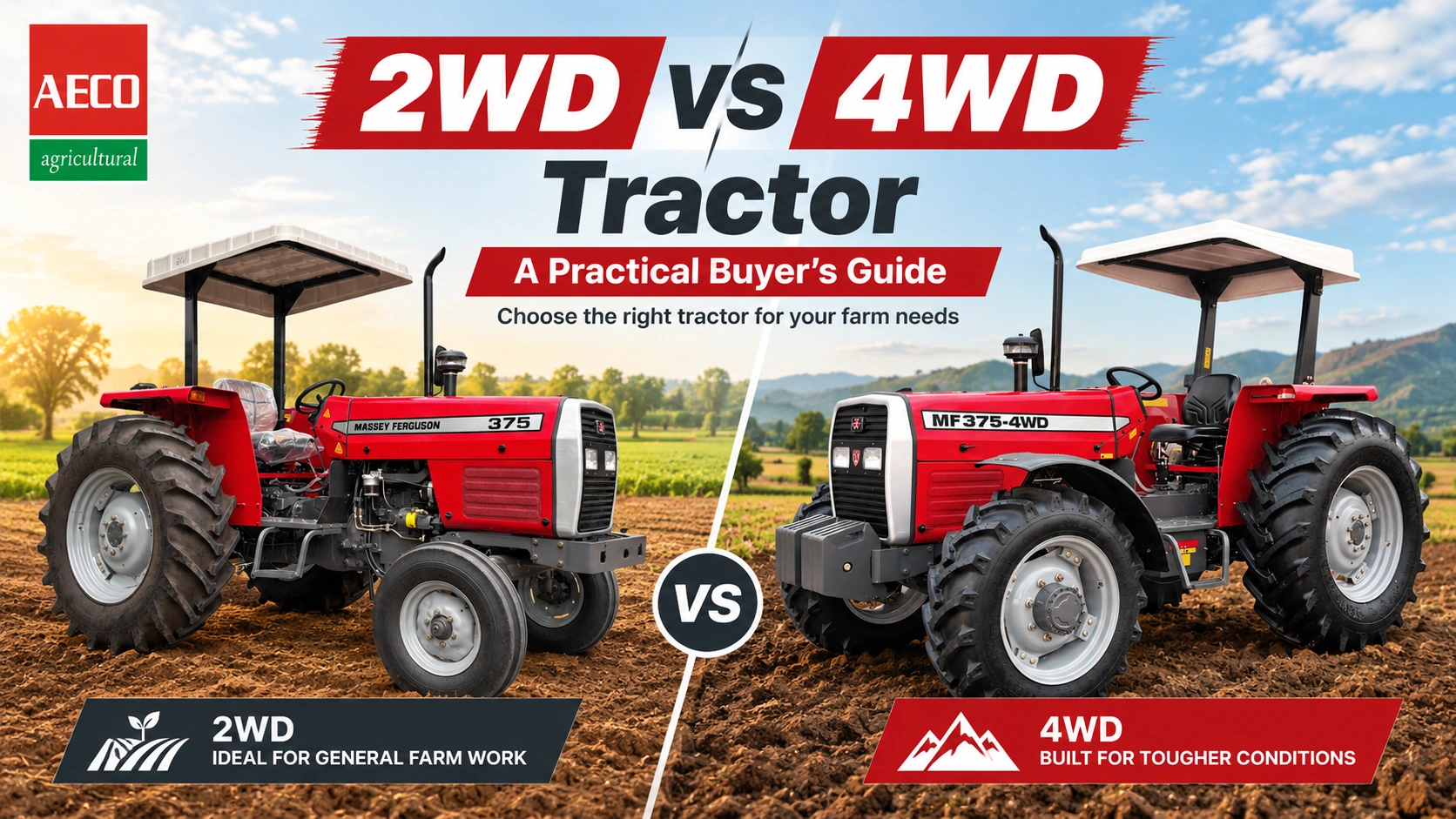
You’re comparing a 2WD and 4WD tractor because the wrong choice will follow you through every season. A medium farm may be deciding between a 2WD Massey Ferguson 375 and its 4WD counterpart, weighing a lower purchase cost against the ability to enter wet fields, pull heavier implements, and keep work moving after rain. The right answer isn’t automatically 4WD. It depends on soil moisture, implement draft, slope, transport cycles, service access, and resale demand.
The same decision appears across the Gulf, Africa, and the Middle East. A date-palm operator may value maneuverability and road hauling, while a Sub-Saharan row-crop farm may need traction in loose soil. A mixed Iraqi wheat-and-barloot operation may use one tractor for cultivation, trailers, and loader work. The Massey Ferguson and New Holland platforms can serve all these markets, but the drivetrain must match the work.
| Decision factor | 2WD tractor | 4WD or MFWD tractor |
|---|---|---|
| Powered wheels | Rear wheels only | Front and rear wheels |
| Best operating fit | Flat, firm ground, transport, spraying, light tillage | Wet soil, slopes, heavy tillage, loaders |
| Purchase position | Lower-to-middle price band | Middle-to-upper price band |
| Mechanical complexity | Simpler | More components to service |
| Traction under difficult conditions | Limited by rear-wheel grip | Stronger traction and stability |
| Turning and road work | Often easier and lighter | More capable, but potentially over-specified for light hauling |
| Main recommendation | Choose when most work is light or transport-focused | Choose when heavy draft and difficult access dominate |
The practical question is simple: which drivetrain earns its keep on your farm?
Why This 2WD vs 4WD Tractor Decision Matters
A tractor buyer often starts with the sticker price. That’s understandable, especially when a farm needs several machines, but price alone can hide the cost of lost field time, extra wheel slip, ballast, tire wear, and unsuitable implements. A 2WD tractor can be the smarter purchase when most work happens on firm, level ground. A 4WD tractor can justify its higher cost when traction determines whether the implement works at full depth.
The U.S. market shows how strongly 2WD remains tied to everyday utility work. In June 2024, U.S. farm tractor sales included 22,562 2WD units for the month and 113,036 units year to date, compared with 308 4WD units for the month and 1,923 units year to date, according to the June 2024 AEM agricultural machinery report. That makes 2WD the mass-market default, particularly in lower horsepower bands where buyers prioritize affordability, straightforward maintenance, and local serviceability.
The same tractor can face different economics
A Gulf farm may spend much of its year moving trailers between date-palm blocks, applying sprays, mowing, and handling lighter mounted implements. A 2WD MF 375 can make sense there if the ground is firm and the tractor spends significant time on roads.
A farm working heavy clay or wet paddy ground faces another calculation. Controlled traction testing found that 4WD tractors reached tractive-efficiency values of about 0.60 to 0.70 at the same slip, while 2WD performance was roughly 15% to 25% lower, with the advantage increasing on more difficult soils, as reported in this controlled tractor traction study. In that setting, a lower-priced 2WD may spend more time spinning, waiting for drier conditions, or requiring lighter passes.
My buying rule: Don’t ask whether 4WD is better. Ask whether your hardest regular task needs power at the front axle.
A drivetrain also affects what happens after the sale. Parts availability, technician familiarity, tire selection, ballast requirements, and resale demand all matter. Buyers in export markets should judge the tractor over its working life, not just the day it leaves the dealer.
How Each Drivetrain Delivers Power to the Ground
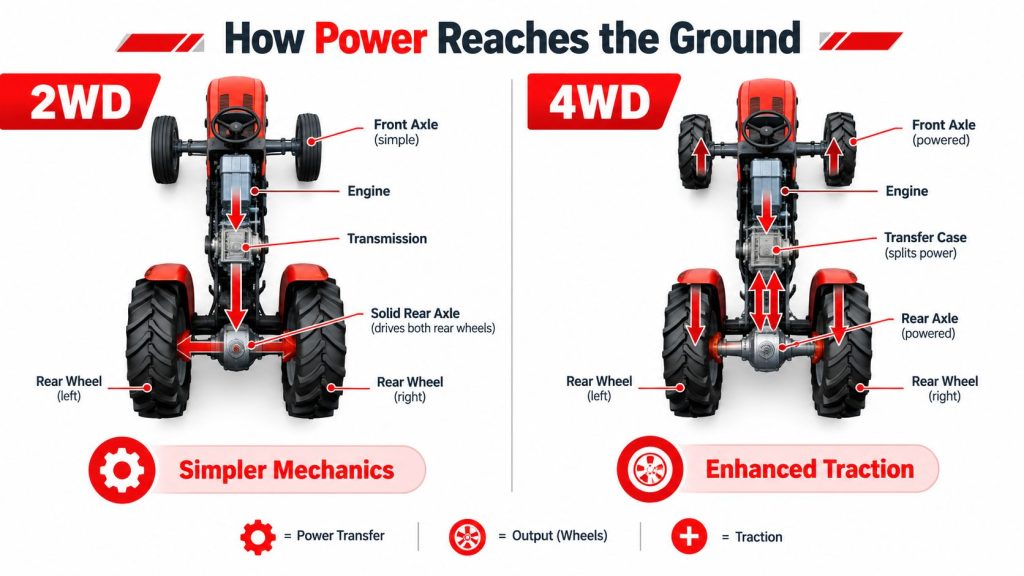
A 2WD tractor sends engine torque through the transmission to the rear axle. The large rear tires provide propulsion, while the front wheels mainly steer and support the front of the tractor. Because the front wheels don’t pull, rear-wheel weight, tread condition, tire pressure, and ballast have a direct effect on usable traction.
A 4WD tractor in the 50–90 HP class is usually an MFWD configuration, or mechanical front-wheel drive. A driveshaft connects the transmission or transfer system to a front axle with its own differential. Engine torque reaches both axles, so the front tires help pull the tractor instead of just following the rear wheels.
What the operator feels
In a 2WD tractor, a heavy implement can transfer weight away from the front and overload the rear tires with slip. The operator may respond with ballast, lower gears, reduced implement depth, or a slower work rate. The machine remains simple, but the usable pulling limit arrives sooner on soft ground.
An MFWD tractor adds powered front wheels and normally carries a heavier front axle. The plan for this class of machine commonly includes roughly 250–400 kg of additional chassis weight and MFWD engagement while moving, with many modern units automatically locking out above about 14 km/h, as specified in the operating guidance for this comparison. Those figures must be confirmed against the exact model and transmission before ordering.
The extra weight and hardware aren’t free. The front axle, differential, driveshaft, universal joints, seals, and related components add inspection points. The benefit is that the tractor can use more of its engine output before the rear wheels lose grip.
For a practical example, the New Holland 480 Tractor is listed by AECO Tractors for farming and agricultural operations. Whether a buyer selects a 2WD or MFWD configuration, the important question is how the machine will be ballasted, which implements it will pull, and how often it will work on surfaces where front-wheel assistance provides a real advantage.
Traction, Fuel Use, and Maintenance Compared
The short version is that 2WD wins on simplicity and light-duty ownership, while 4WD wins when the tractor must convert engine power into drawbar pull on difficult ground. The difference isn’t only about whether the tractor moves. It’s about how much slip, ballast, time, and fuel the operator accepts while completing the task.
A Japanese traction-ratio review reported maximum drawbar pull for 4WD tractors at 1.4–1.6 times that of 2WD tractors under equivalent weight and slip conditions. The same review reported a maximum traction ratio of about 0.85 for 4WD versus 0.5–0.6 for 2WD, with maximum tractive-efficiency ranges of 6–42% for 4WD and 2–28% for 2WD, as documented in this JIRCAS tractor performance review.
| Metric | 2WD Tractor | 4WD or MFWD Tractor |
|---|---|---|
| Traction | Adequate on firm, level ground | Higher usable pull in soft, loose, or sloping conditions |
| Fuel use | Often favorable for light work and transport | Can use diesel more effectively during heavy draft by reducing slip |
| Purchase position | Lower-to-middle price band | Middle-to-upper price band, generally higher upfront |
| Mechanical layout | Rear axle and simpler front end | Powered front axle, differential, driveshaft, and related joints |
| Maintenance | Simpler and cheaper to maintain | More inspection and service points |
| Tire demand | Rear tires carry most traction work | All four tires contribute, with greater front-axle load |
| Best ownership case | High road use, spraying, mowing, light tillage | Heavy plowing, loaders, wet fields, slopes |
Fuel use needs careful interpretation. A 2WD tractor can be economical when it has sufficient grip and isn’t forced to spin. Under demanding work, however, reduced slip can outweigh the friction added by the extra drivetrain. One comparison reports that 4WD can operate 15–30% more efficiently in diesel consumption under demanding conditions, while an academic test found the 4WD system had the lowest fuel consumption at a 10 kN pulling force,.
Ownership is a service question
A 2WD front axle is mechanically simpler. That usually means fewer components, easier troubleshooting, and lower maintenance costs, a pattern also described in this 2WD and 4WD tractor maintenance comparison. A 4WD tractor adds capability, but the buyer should budget for front-axle oil, seals, universal joints, steering components, and tire matching.
Keep a written service schedule and check the correct intervals for the exact model. AECO’s essential tractor maintenance tips can help buyers organize routine inspections, but it shouldn’t replace the manufacturer’s manual or the exporting dealer’s pre-shipment specification sheet.
Soil, Slope, and Implement Draft Realities
Soil decides the drivetrain more reliably than brand loyalty. Sandy loam can lose grip quickly when disturbed, while heavy clay can remain difficult long after the surface looks workable. A tractor that performs well during dry-season transport may struggle during the short planting or tillage window after rainfall.
The most useful evidence comes from controlled testing rather than a simple “mud versus dry land” description. The traction study cited earlier found a clear 4WD advantage across tested surfaces, especially as conditions became harder. The JIRCAS review likewise recorded materially higher drawbar pull and traction ratios for 4WD under equivalent conditions.
The exact slip values for a particular MF 360, MF 470, soil moisture level, or implement must be measured or confirmed from model-specific testing. They shouldn’t be invented from a general drivetrain comparison. A buyer can still make a firm decision by rating the field conditions that occur most often.
| Condition | 2WD Slip | 4WD Slip | Draft load | Recommended drivetrain |
|---|---|---|---|---|
| Firm, level ground for spraying | Usually manageable | Low, with no major traction requirement | Light | 2WD |
| Sandy or recently disturbed soil | Higher risk of rear-wheel spin | Better traction efficiency | Moderate to heavy | 4WD if draft work is regular |
| Wet clay or paddy access | Traction can become the limiting factor | Stronger pull and field access | Heavy | 4WD |
| Flat road transport | Usually suitable | Capable, but may add unnecessary complexity | Trailer-dependent | 2WD for transport-focused fleets |
| Uneven or sloping land | Stability and pull are limited | Better control and power transfer | Moderate to heavy | 4WD |
Draft changes the answer
A three-bottom moldboard plow, deep ripper, or heavy offset disc demands sustained drawbar pull. If the rear tires spin before the implement reaches working depth, the operator loses time and may compact the same track through repeated passes. A 4WD tractor can maintain forward movement more effectively because all four wheels contribute.
A two-ton tipping trailer presents a different use pattern. On firm roads, a 2WD tractor may handle the cycle efficiently and turn more tightly. On a wet loading area, incline, or soft field entrance, the 4WD advantage becomes more valuable.
Slope is equally important. A flat farm with short transport runs doesn’t need the same traction reserve as an operation working rolling ground or orchard blocks. For slopes, the buyer should consider braking, ballast, tire condition, rollover protection, and operator training alongside the drivetrain. 4WD improves control, but it doesn’t make unsafe loading or poor driving safe.
Matching 50–90 HP Models to Your Tasks
The best model is the one that matches the task performed most often, not the most demanding job performed once each year. In export orders, I separate the decision into four operating profiles: light field work, heavy draft, loader cycles, and transport. That approach prevents buyers from paying for capability they rarely use, while avoiding a false saving on farms where traction determines productivity.
| Model | Drivetrain | HP range | Best-fit task | Terrain suitability |
|---|---|---|---|---|
| MF 360 | 2WD | 50–90 HP class | Spraying, mowing, light tillage, transport | Flat and firm fields |
| MF 375 | 2WD | 50–90 HP class | Hay work, road hauling, general utility work | Flat to gently rolling ground |
| MF 470 | 4WD | 50–90 HP class | Heavy plowing, deep ripping, loader work | Clay, loose soil, and slopes |
| MF 480 | 4WD | 50–90 HP class | Draft work and mixed heavy-duty operations | Difficult or traction-limited ground |
| New Holland TD5050 | 4WD | 50–90 HP class | Heavy implement work and loader operations | Uneven, sloping, or soft fields |
My verdict by common job
Loader cycles: Choose 4WD when the loader repeatedly enters a pile, works on loose ground, or carries loads across uneven surfaces. Front-wheel assistance helps the tractor move into the load instead of relying only on rear-tire grip.
Three-disc or heavy plowing: Choose 4WD if the soil is clay, moisture changes quickly, or the implement must run at consistent depth. Choose 2WD only when the field is firm and the tractor has enough rear traction without excessive ballast.
Planter pulling: A 2WD MF 360 or MF 375 can suit flat, prepared fields where draft demand is moderate. A 4WD MF 470, MF 480, or New Holland TD5050 is the safer choice when the planter is heavy, the seedbed is loose, or the field slopes.
Road transport: Favor 2WD for a tractor whose main role is trailer hauling on firm roads and yard work. It’s lighter in operating feel and avoids paying for front-drive hardware that may remain disengaged. If the same tractor must leave the road and pull through soft farm tracks, choose MFWD.
Before ordering a 385, compare the MF 385 2WD and MF 385 4WD configurations by task, not by badge. The model name matters less than axle specification, tire pairing, implement size, and the percentage of annual work that involves high draft.
The Total Cost Case for Each Drivetrain
A 4WD tractor costs more to buy, but the financial decision shouldn’t stop there. Stack the purchase premium against fuel lost through wheel slip, extra passes, ballast, tire wear, service work, and the value of completing field operations during a narrow weather window.
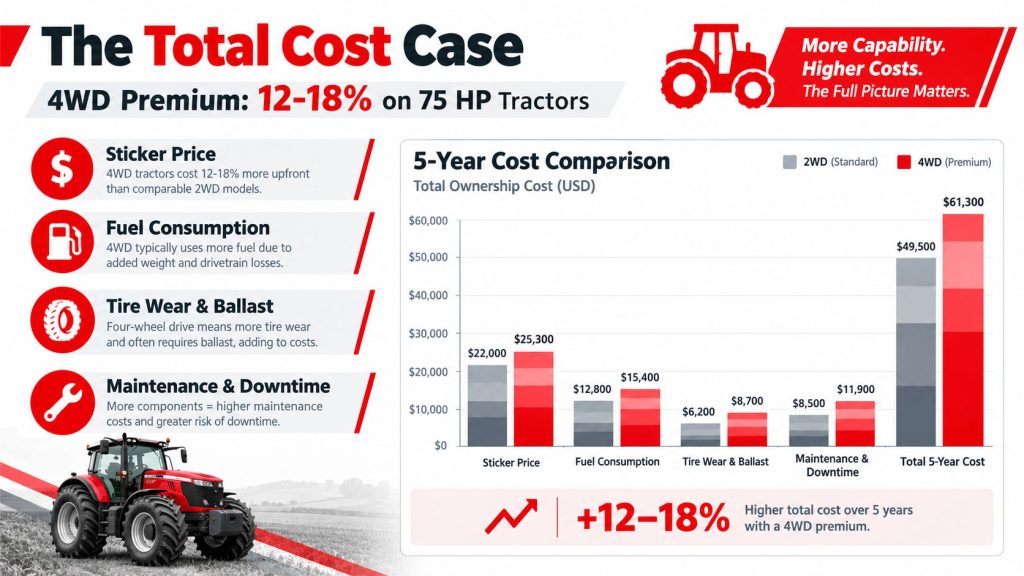
The supplied market guidance places the typical 4WD premium at 12–18% on a 75 HP tractor, a figure represented in the ownership comparison below. Treat it as a planning range, not a quotation. Prices are always given on contact on WhatsApp or Email.
The cost case becomes stronger for 4WD when heavy work dominates. A 2WD tractor may need slower speeds, shallower passes, or repeated attempts in wet clay. A 4WD tractor can often maintain more consistent pull, which may reduce the hidden cost of lost time. The benefit is task-dependent, and a farm that mainly sprays, mows, and hauls on roads may never recover the premium through field productivity.
Where the extra money goes
- Sticker price: The 4WD configuration carries the initial premium because it adds a powered front axle and associated drivetrain components.
- Fuel consumption: On light work, 2WD may be more economical. During heavy draft, 4WD can reduce slip-related waste and use fuel more effectively.
- Tire wear and ballast: 2WD often needs rear ballast for traction. 4WD distributes pulling work across all wheels, but the front axle and tires carry more responsibility.
- Maintenance and downtime: 2WD has fewer drivetrain service points. 4WD needs disciplined inspection of the front axle, driveshaft, joints, seals, and matching tires.
A precise break-even hectare figure requires the actual tractor quotation, implement width, soil conditions, annual workload, fuel price, operator rate, and service costs. Without those inputs, any exact payback calculation would be fiction. Use your farm records instead. If heavy tillage occupies most operating hours and rain regularly closes the field window, 4WD is usually the economically safer specification. If road transport and light operations dominate, 2WD usually protects capital better.
Practical Buyer Questions Before You Order
Buyers often ask about resale first, but resale follows use case. A well-maintained 4WD tractor can attract stronger interest where farms need heavy draft, loader work, wet-field access, or sloping-ground stability. A clean 2WD tractor remains highly practical for transport, spraying, mowing, and flat-land cultivation, particularly where local mechanics and buyers prefer simpler machines.
Ask the exporter to confirm whether MFWD engagement can occur while moving, whether the front axle is intended for continuous use or selective engagement, and which speeds or surfaces require disengagement. Don’t assume every 4WD system operates identically. The operator’s manual and model specification should control.
Tires and ballast need to match the work
R1 agricultural tires are the normal starting point for field traction. Consider R4 industrial tires when the tractor spends substantial time on hard surfaces, yards, construction-style work, or transport routes where sidewall durability matters more than maximum soil bite. Dual rear wheels can suit transport-heavy or high-load applications, but the axle, clearance, road width, and local regulations must be checked before approval.
Use ballast to keep the tractor stable and improve tire contact, not only to make it heavier. A 2WD tractor generally depends more heavily on rear ballast during draft work. A 4WD tractor still needs correct front-to-rear balance, especially with a loader or mounted implement. Sprayers, mowers, seed drills, and light trailers may often be used without MFWD engaged on firm surfaces, while heavy plowing, deep ripping, loader entry, and soft-field work call for front-wheel assistance.
| Buyer question | 2WD answer | 4WD answer |
|---|---|---|
| Will it resell well? | Strong fit for simple, flat-land, and transport work | Strong fit for heavy draft, loader, wet-field, and slope work |
| Is MFWD engagement relevant? | Not applicable | Confirm on-the-go operation and approved engagement conditions |
| What tire setup is suitable? | Prioritize rear traction and road suitability | Match all four tires and protect front-axle geometry |
| Is ballast required? | Often important for heavy drawbar work | Still necessary, but distribute it correctly |
| Which implements suit it? | Sprayers, mowers, light tillage, and trailers on firm ground | Plows, rippers, loaders, and heavy planters in difficult conditions |
| What should shipping documents show? | Tractor specification, inspection, and parts documentation | The same, plus front-axle and MFWD specification details |
Before signing, use a written specification sheet. Confirm engine and transmission details, drivetrain, tire sizes, ballast arrangement, PTO and hydraulic requirements, implement compatibility, inspection records, warranty documents, and export paperwork. Ask how front-axle build details will be verified on the shipped unit, and request the spare-parts kit for the exact drivetrain configuration rather than accepting a generic package.
For broader model-selection guidance, use AECO’s guide to choosing the right tractor for your farm. It should support, not replace, a task list covering soil, slope, annual transport cycles, implement draft, service access, and resale expectations.
AECO Tractors supplies Massey Ferguson and New Holland tractors, attachments, spare parts, inspection support, and containerized export logistics for buyers across the Gulf, Africa, and the Middle East. Send your soil conditions, main implements, transport requirements, and preferred horsepower range, then visit AECO Tractors to request a 2WD or 4WD specification and quotation.