Not sure which model fits your farm?
Get in touch with the AECO Tractors team on WhatsApp. We work directly with buyers in Tanzania and across East Africa to match the right tractor to your specific farming operation.

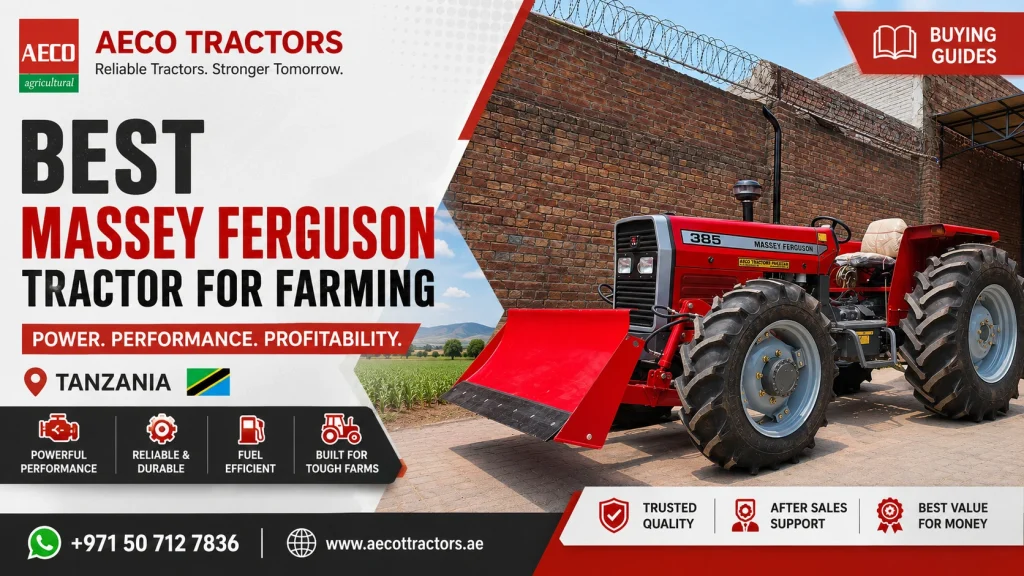
The best Massey Ferguson tractor for farming in Tanzania depends on your farm size, soil type, and the implements you plan to use. For smallholder farms under 20 acres, the MF 240 (50hp) offers reliable performance and low running costs. For medium to large farms handling maize, rice, or sunflower cultivation, the MF 360 (60hp) and MF 375 (75hp) provide more pulling power and better implement compatibility. Farms operating across heavy clay soils or hilly terrain in regions like Mbeya, Iringa, or Morogoro will benefit from the added torque and 4WD options available on the MF 385 and MF 390 series.
Choosing the wrong tractor is one of the most expensive mistakes a farmer can make. Buy too small, and you are constantly underpowering your implements. Buy too large, and your fuel costs and maintenance bills eat into your margins before the harvest even begins.
Tanzania’s farming landscape is diverse. From the flat, expansive plains of Dodoma to the high-altitude farms of Mbeya and the rice-growing lowlands of Morogoro, soil conditions, field sizes, and crop types vary significantly across the country. That means there is no single correct answer when buyers ask which Massey Ferguson model is the best.
What this guide does is walk you through the most practical considerations — farm size, crop type, terrain, implement requirements, and total cost of ownership — and match them to the Massey Ferguson models most commonly used and most readily supported in Tanzania.
Massey Ferguson has maintained a strong presence in East Africa for decades, and Tanzania is no exception. The brand’s dominance in this market is not purely a matter of legacy. There are practical reasons why Tanzanian farmers, cooperatives, and commercial agriculture operations keep coming back to MF tractors.
Parts availability is the most significant factor. Massey Ferguson components are widely stocked by dealers and agro-input shops across Tanzania, from Dar es Salaam to Arusha and into rural distribution networks. When a tractor breaks down during planting or harvesting season, access to spare parts within days rather than weeks is not a luxury — it is the difference between a successful season and a significant financial loss.
Mechanical simplicity is the second reason. Many MF models in the 200, 300, and 400 series use straightforward engine and transmission designs that local mechanics can service without specialist equipment. This matters enormously in areas where certified dealer workshops are not within easy reach.
Resale value holds reasonably well compared to less established brands in the Tanzanian market. A well-maintained MF tractor retains buyer confidence, which is relevant if you are planning to upgrade in three to five years.
Before comparing horsepower figures and transmission options, it is worth stepping back and being honest about what your operation demands. Many buyers focus on the tractor itself when the real starting point should be the work the tractor needs to do.
A 10-acre maize farm on relatively flat land has very different requirements from a 200-acre mixed crop operation on varying terrain. As a general working guide:
– Under 20 acres: A 45hp to 55hp tractor handles most light to medium tillage, planting, and transport work efficiently.
– 20 to 80 acres: The 60hp to 75hp range gives you more flexibility across heavier tillage, larger implements, and longer operating hours.
– 80 acres and above: Farms at this scale typically need 75hp or higher, especially if you are running multi-row planters, large disc ploughs, or subsoilers.
These are not rigid categories. Soil type matters as much as acreage. Heavy black cotton soils or compacted clay — common in parts of the Rift Valley corridor — demand more pulling power than light loam. A 60hp tractor working heavy clay soil may struggle with a three-disc plough where a 75hp machine handles it comfortably.
Tanzania’s major crops include maize, rice, cassava, sunflower, cotton, and increasingly, horticulture. Each places different demands on your machinery.
Rice farming in lowland areas like Kilombero or the Rufiji basin often involves wet field preparation, which puts heavy strain on the drivetrain and requires good ground clearance and robust axle seals. Maize and sunflower cultivation across the central and southern highlands typically involves primary tillage, secondary tillage, planting, and transport — a full range of operations that benefit from a versatile mid-range tractor.
Cotton farming in regions like Shinyanga involves large-scale land preparation and spraying operations, where a higher-horsepower tractor with a reliable PTO is important.
This is one of the most overlooked factors in tractor buying decisions. A tractor is only as useful as its ability to work with the implements you need. Before selecting a model, confirm:
– Three-point linkage category: Smaller tractors use Category I linkage. Larger implements require Category II. Mismatched linkage means you cannot attach the implement at all, or it will not operate safely.
– PTO speed and output: Most Tanzanian farm implements are designed for 540 RPM PTO. Confirm the tractor’s PTO specification matches your equipment.
– Hydraulic lift capacity: If you are running heavy disc harrows or a loader, the hydraulic system needs sufficient lift capacity. Underpowered hydraulics are a common complaint on cheaper tractors.
The following section covers the MF models most relevant to Tanzania’s farming environment. These are models with established parts support, proven performance in East African conditions, and a track record across smallholder and commercial operations.
Horsepower: 50hp
Engine: 3-cylinder Perkins diesel
Transmission: 8 forward, 2 reverse
Drive: 2WD (4WD variants available in some configurations)
PTO: 540 RPM
Linkage: Category I & II
The MF 240 has been a fixture on small and medium farms across Tanzania for many years. Its 3-cylinder Perkins engine is one of the most well-understood diesel engines in the country. Mechanics in even moderately rural areas are familiar with it, and parts are consistently available through established supply chains.
For a farmer working 10 to 25 acres of maize, beans, or mixed vegetables, the MF 240 handles light disc ploughing, rotavation, planting, and transport without difficulty. It is not a heavy tillage machine, and pushing it to pull a large three-disc plough in hard soil will shorten its service life. Used within its design parameters, it is one of the most cost-effective tractors available in this market.
Where it works well: Smallholder farms, school farms, cooperative plots, horticultural operations, light transport.
Where it struggles: Heavy primary tillage on large acreage, compacted soils, wet paddy field preparation over extended seasons.
Horsepower: 60hp
Engine: 3-cylinder turbocharged diesel
Transmission: 8 forward, 2 reverse
Drive: 2WD standard
PTO: 540 RPM
Hydraulics: Improved lift capacity over MF 240
The MF 360 sits in a useful middle ground. It offers meaningfully more power than the MF 240 without the higher purchase and operating costs of the 75hp-plus range. The turbocharged engine gives it better torque response under load, which matters when you are pulling a disc harrow through dry, cracked soil at the start of the long rains.
For farmers in the 25 to 60 acre range growing maize, sunflower, or mixed crops, the MF 360 covers the full cycle of operations — primary tillage, secondary tillage, planting, and post-harvest transport — with a reasonable fuel economy profile.
Where it works well: Medium-scale grain farming, sunflower and maize cultivation, farms transitioning from manual to fully mechanized operations, tractor hire services covering multiple smallholder clients.
Where it struggles: Large-scale primary tillage operations, multi-row planting equipment that demands higher hydraulic output, sustained heavy work in wet rice paddies.
Horsepower: 75hp
Engine: 4-cylinder Perkins diesel
Transmission: 8 forward, 2 reverse (synchromesh)
Drive: 2WD and 4WD options
PTO: 540
Hydraulics: Category II, higher lift capacity
Linkage: Category I & II
The MF 375 is the model that consistently appears in conversations with experienced Tanzanian farmers and agricultural machinery consultants when the question is about all-round capability. It sits at a practical intersection of power, versatility, and running cost.
The PTO 540 is a significant practical advantage. It expands the range of implements you can run, including equipment designed for higher PTO speeds such as certain rotary tillers and forage equipment. The 8-speed transmission gives you more precise speed control for different operations — slower for precise planting, faster for transport.
The 4WD variant of the MF 375 is particularly relevant for farms in hilly areas like the Southern Highlands (Mbeya, Njombe, Iringa) or in wet conditions where traction is a consistent challenge. Four-wheel drive is not just about getting unstuck — it reduces wheel slip during tillage, which directly improves fuel efficiency and reduces soil compaction from spinning wheels.
Where it works well: Commercial grain farms of 50 to 200 acres, mixed crop operations, farms running multiple implements across different seasons, tractor hire operations serving medium and large clients, tobacco and cotton farming.
Where it struggles: Very small farms where the operating costs are disproportionate to the acreage. Buyers on tight budgets who only need light work may find the MF 375 more tractor than their operation currently justifies.
Horsepower: 85hp
Engine: 4-cylinder Perkins diesel
Transmission: 8 forward, 2 reverse
Drive: 2WD and 4WD options
PTO: 540
Hydraulics: High-capacity Category I & II
The MF 385 is the right choice for farms where productivity demands are high and downtime is genuinely costly. It handles large three-disc and four-disc ploughs, heavy-duty disc harrows, subsoilers, and multi-row planters without the strain that smaller models would experience.
Commercial farms in the Kilosa, Morogoro, and Mbeya corridors growing maize or rice at scale, as well as sugar outgrower schemes and large tobacco estates, are the natural users of this model. The additional horsepower also makes a practical difference when operating on slopes, where the effective pulling power of a tractor drops relative to the gradient.
For farming operations that run double shifts during land preparation season, the MF 385 has the durability and thermal management to handle sustained heavy work better than mid-range models.
Where it works well: Large-scale grain and cash crop farms, commercial rice schemes, tobacco and cotton estates, land clearing operations, farms running heavy implements.
Where it struggles: The higher initial cost and fuel consumption make it difficult to justify for farms under 80 acres unless those farms have very specific heavy-work requirements.
Horsepower: 90hp
Transmission: 8 forward, 2 reverse
Drive: 4WD standard on most configurations
The MF 390 is positioned at the upper end of the conventional utility tractor range. For Tanzanian buyers, this model makes most sense for large commercial operations, irrigation schemes, or farms with significant land preparation requirements on challenging terrain.
It is also relevant for agricultural contractors who need a single tractor capable of handling the widest range of client requirements, from subsoiling to baling to heavy transport.
| Model | Horsepower | Best Farm Size | Drive Options | Dual PTO | Ideal For |
|---|---|---|---|---|---|
MF 240 | 50HP | Under 25 acres | 2WD | No | Smallholder, light work |
MF 360 | 60HP | 25–60 acres | 2WD / 4WD | No | Medium farms, grain |
MF 375 | 75HP | 50–150 acres | 2WD / 4WD | No | Versatile commercial use |
MF 385 | 85HP | 80–250 acres | 2WD / 4WD | No | Heavy commercial farming |
90HP | 150+ acres | 2WD / 4WD | No | Large estates, contractors |
Get in touch with the AECO Tractors team on WhatsApp. We work directly with buyers in Tanzania and across East Africa to match the right tractor to your specific farming operation.
This question comes up frequently and deserves a direct answer. Two-wheel drive tractors are cheaper to purchase and maintain, and for many flat, well-drained farms they perform perfectly well. However, Tanzania’s farming regions present conditions where 4WD provides a genuine operational advantage rather than just a marketing feature.
When 4WD makes practical sense in Tanzania:
– Farms in the Southern Highlands where slopes are common and wet season conditions make traction difficult
– Rice farming operations where the tractor regularly enters waterlogged or saturated fields
– Farms with heavy clay soils that become extremely slippery when wet
– Operations where the tractor is used for loading, transport, or working on uneven ground
When 2WD is sufficient:
– Flat, well-drained farms in drier regions
– Operations primarily involving light tillage, planting, and road transport
– Buyers where budget is a primary constraint and the terrain does not demand 4WD
One practical consideration: if you are buying a 2WD tractor and anticipate needing better traction, ensure you have access to ballast weights for the rear wheels. Proper ballasting significantly improves traction on 2WD machines and is often overlooked by first-time buyers.
A tractor without the right implements is like a vehicle without fuel — it has potential but cannot deliver results. Tanzania’s farming operations typically require some combination of the following:
Primary tillage: Disc ploughs (2, 3, or 4 disc depending on tractor size), mouldboard ploughs for certain soil types.
Secondary tillage: Disc harrows, offset disc harrows, rotary tillers (power harrows).
Planting: Maize planters, sunflower planters, multi-crop seed drills.
Post-harvest: Trailers for grain transport, shelling equipment driven by PTO.
Crop protection: Boom sprayers (trailed or 3-point mounted).
When selecting your tractor, work backwards from the implements you need. If you plan to run a 3-disc plough for primary tillage, confirm that the tractor’s hydraulic lift capacity and horsepower are adequate for that specific implement in your soil conditions. Implement dealers and agricultural extension officers in Tanzania can provide guidance on matching implement size to tractor capacity.
AECO Tractors supplies a range of tractor implements alongside Massey Ferguson machines, which simplifies the process of ensuring compatibility from the point of purchase.
The purchase price of a tractor is only one part of the financial picture. Experienced buyers evaluate total cost of ownership, which includes:
Fuel consumption: A 50hp tractor working light soil might consume 4 to 6 litres of diesel per hour. A 90hp tractor under heavy load can consume 8 to 12 litres per hour. Over a full season, this difference is substantial.
Maintenance schedule: Massey Ferguson tractors in this range require engine oil changes, filter replacements, and hydraulic fluid checks at defined intervals. Neglecting maintenance is the primary cause of premature engine failure in the Tanzanian market. Budget for this from day one.
Parts and service access: Before purchasing any tractor, confirm that the specific model’s parts are available in your region or through a reliable supply chain. This is one area where Massey Ferguson has a genuine advantage in Tanzania — the supply infrastructure for MF parts is more developed than for many competing brands.
Operator training: An untrained operator can cause significant mechanical damage within a single season. If your farm does not have an experienced tractor operator, factor in training costs or hire someone with documented experience on the specific model.
This is a practical question for many Tanzanian buyers, particularly smallholder farmers and small cooperatives where capital is limited.
New tractors offer warranty coverage, the latest mechanical specifications, and predictable maintenance schedules. For commercial operations where downtime is costly, the peace of mind that comes with a new machine is often worth the premium.
Reconditioned tractors — particularly units refurbished to high standards before export — can represent genuine value, provided the reconditioning has been done properly. Key things to verify include engine hours, condition of the hydraulic system, clutch and transmission wear, and whether the machine has been painted to hide damage rather than genuinely repaired.
AECO Tractors exports both new and reconditioned Massey Ferguson tractors from the UAE, with machines prepared to a standard appropriate for demanding African farming conditions. Buyers importing directly should ensure they are working with an established exporter who can provide documentation, inspection reports, and clear communication about the machine’s condition and history.
For buyers purchasing from overseas suppliers rather than through local dealers, there are several practical points to understand.
Customs and import duties: Tanzania applies import duties and VAT on agricultural machinery imports. The specific rates can vary and are subject to policy changes. Engage a licensed clearing agent in Dar es Salaam who has experience handling agricultural machinery imports.
Port of entry: Dar es Salaam port is the primary entry point for most machinery imports into Tanzania. Transit times from the UAE & Pakistan typically range from 15 to 25 days depending on shipping line and vessel schedule.
Documentation: Ensure your supplier provides a clean Bill of Lading, commercial invoice, packing list, and any applicable certificates of conformity or inspection. Missing documentation causes delays and additional costs at the port.
Pre-shipment inspection: For reconditioned units especially, consider requesting a pre-shipment inspection report or video documentation of the machine before it is loaded. This protects you against receiving a machine that does not match what was described.
AECO Tractors has experience handling exports to East Africa, including Tanzania, and can advise buyers on documentation requirements and logistics arrangements.
If you are still unsure which model fits your operation, work through these questions:
Your answers will point clearly toward a specific horsepower range and whether 2WD or 4WD is appropriate. If you answer these questions honestly, the model selection becomes significantly more straightforward.
Tanzania’s agricultural regions each have distinct characteristics that influence tractor selection.
Northern Zone (Arusha, Kilimanjaro, Manyara): Mixed smallholder and commercial farming, horticulture, coffee, and maize. Varied terrain including volcanic soils and slopes. The MF 375 4WD and MF 385 are well-suited to commercial operations here. Smallholders working flat plots can manage with the MF 240 or MF 360.
Central Zone (Dodoma, Singida): Predominantly dryland farming, maize, sorghum, and sunflower. Soils can be hard and compacted during dry season, requiring adequate horsepower for primary tillage. The MF 360 to MF 375 range is appropriate for most operations.
Southern Highlands (Mbeya, Njombe, Iringa, Songwe): High-altitude farming with significant rainfall, fertile soils, and slopes. Tea, coffee, maize, and wheat. 4WD is strongly recommended here. The MF 375 4WD and MF 385 are the most practical choices for medium to large farms.
Eastern Zone (Morogoro, Coast Region): Rice, maize, and cassava. Wet conditions in rice-growing areas demand robust machines with good ground clearance and strong axle protection. The MF 375 and MF 385 handle these conditions well.
Western and Lake Zone (Mwanza, Shinyanga, Tabora, Kigoma): Cotton, maize, and rice across varied terrain. Large commercial farms in this zone benefit from the MF 385 and MF 390 for sustained heavy work.
Ready to discuss which Massey Ferguson model fits your farm? Contact AECO Tractors for direct buyer support.
For small farms up to 25 acres, the Massey Ferguson MF 240 (50hp) is the most practical choice. It handles light to medium tillage, planting, and transport work efficiently, with low fuel consumption and widely available spare parts across Tanzania.
Yes. The MF 375 is one of the most versatile and widely used tractors in Tanzania’s commercial farming sector. Its 75hp output, dual-speed PTO, and availability in 4WD configuration make it suitable for a broad range of crops and soil conditions, particularly in the Southern Highlands and central grain-growing regions.
The MF 360 offers 60hp and is suited to medium-scale operations on relatively flat, manageable terrain. The MF 375 provides 75hp, a dual-speed PTO (540/1000 RPM), a more advanced transmission, and 4WD options. For farms over 50 acres or those running heavier implements, the MF 375 is the more capable and future-proof choice.
It depends on your terrain and soil conditions. For flat, well-drained farms in drier regions, 2WD is sufficient and more cost-effective. For farms in the Southern Highlands, wet rice-growing areas, or on sloping terrain, 4WD provides meaningful improvements in traction, fuel efficiency during tillage, and operational reliability.
Yes. Importing directly from the UAE or Pakistan is a common route for Tanzanian buyers seeking competitive pricing on both new and reconditioned Massey Ferguson tractors. You will need to work with a licensed clearing agent in Dar es Salaam and ensure your supplier provides complete documentation including the Bill of Lading, commercial invoice, and packing list. AECO Tractors in the UAE & Pakistan has experience handling exports to Tanzania and East Africa.
For maize farming, commonly used implements include disc ploughs (2 or 3 disc depending on tractor size), disc harrows for secondary tillage, maize planters (single or multi-row), and transport trailers. Ensure the tractor’s three-point linkage category and PTO speed match the implements you plan to use. The MF 375 and above support Category I & II linkage and dual-speed PTO, giving the widest implement compatibility.
Key maintenance practices include regular engine oil and filter changes (typically every 250 operating hours or as specified in the manual), air filter cleaning in dusty conditions, hydraulic fluid checks, greasing of all linkage and steering points, and checking tyre pressures before each operating day. Keeping a log of operating hours and maintenance intervals significantly extends tractor service life.
AECO Tractors, based in the UAE & Pakistan, supplies Massey Ferguson tractors for export to Tanzania and other East African markets. They offer both new and reconditioned units with export documentation support. Visit www.aecotractors.ae for more information.
AECO Tractors supplies Massey Ferguson tractors and agricultural implements for export to Tanzania and across East Africa. Whether you are equipping a smallholder operation or a large commercial farm, our team can help you identify the right model, confirm implement compatibility, and manage the export process from the UAE to your port of entry.
Contact us at www.aecotractors.ae or reach out directly to discuss your requirements.
Copyright © 2002 – 2026 Aeco Tractors | All Rights Reserved