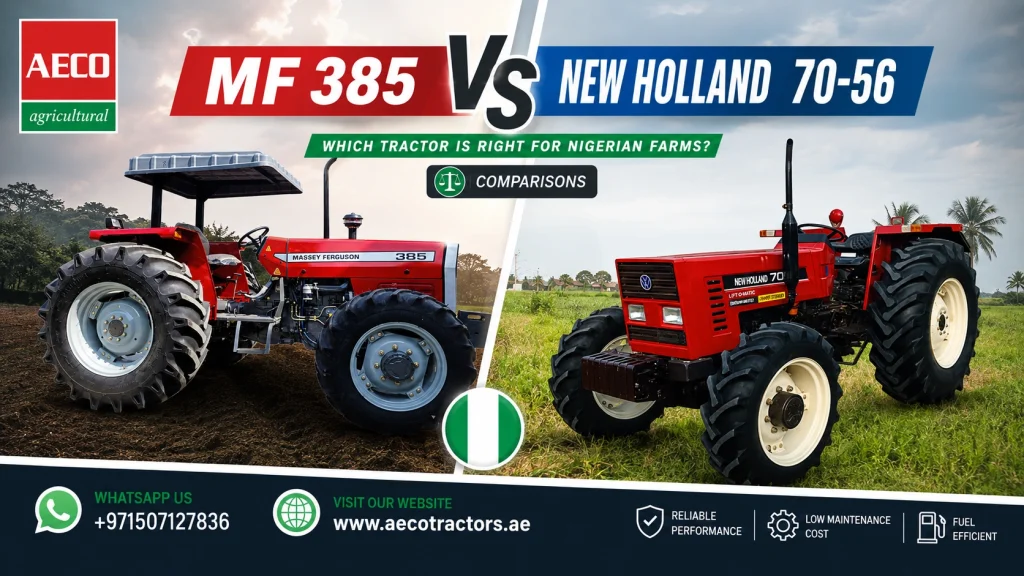
Choosing between the Massey Ferguson 385 and the New Holland 70-56 is one of the most common decisions facing Nigerian tractor buyers today. Both machines are well-established in the West African market. Both handle the heat, dust, and demanding soil conditions that define farming across the Nigerian Middle Belt, the North, and the South-South agricultural zones.
But they are not the same tractor, and the wrong choice for your farm size, crop type, or budget can cost you significantly in fuel, downtime, and output.
This guide gives you a direct, practical comparison of both models so you can make a confident buying decision.
Understanding the Two Tractors: A Quick Background
The MF 385 is manufactured by AGCO under the Massey Ferguson brand and has been a dominant tractor model across sub-Saharan Africa for decades. It is available in both 2WD and 4WD configurations. The 385 runs on a Perkins or Simpson engine depending on production origin, and its reputation in Nigeria is built on one thing above all else: parts are everywhere.
From Kano to Ibadan, from Makurdi to Enugu, you will find MF 385 spare parts in local agro-dealer shops, open-air machinery markets, and certified service centres. That parts availability alone has kept this tractor relevant for over 30 years in the Nigerian market.
The New Holland 70-56 is a slightly more powerful machine, rated at 85HP and built for heavier field operations. New Holland as a brand carries strong credibility in commercial agriculture globally, and the 70-56 has found its footing in Nigeria primarily among larger farm operations, estate farms, and mechanisation service providers who need consistent daily output across large land areas.
The 70-56 is less universally stocked in terms of spare parts compared to the MF 385, but this gap has been narrowing as New Holland’s dealer network in Nigeria continues to expand.
Engine and Power: What the Numbers Actually Mean in the Field
On lighter soils typical of parts of Kogi, Benue, and Oyo states, a 85HP tractor like the MF 385 can comfortably run a three-bottom plough or a medium-width disc harrow without straining. For maize, sorghum, cassava, and groundnut farming on plots ranging from 150 to 200 acres, the MF 385 handles the workload without unnecessary fuel waste.
However, on the heavy clay soils found across parts of the Niger Delta, Taraba, and some Borno State farmlands, that 85HP on the New Holland 70-56 becomes operationally significant. Heavy clay resists tillage tools aggressively. When you are running a four-bottom plough or a heavy offset disc harrow through dense, moisture-retaining soil, the 70-56 maintains its working speed better and puts less mechanical stress on the drivetrain.
The New Holland 70-56 also PTO speed at 540 RPM, which gives it flexibility when running implements that require higher rotational speeds, such as certain rotary tillers and slashers used in plantation agriculture.
The MF 385 runs at 540 RPM PTO, which covers the vast majority of common farm implements used in Nigeria but limits options for higher-speed implement requirements.
Hydraulics: A Practical Consideration Often Overlooked
Hydraulic lift capacity determines how heavy an implement you can attach and raise cleanly at the headland when turning.
The New Holland 70-56’s hydraulic system handles heavier rear-mounted implements more comfortably. If you are running a heavy subsoiler, a large ridger, or a combination seed-and-fertiliser planter, the stronger hydraulic system on the 70-56 gives you more operational confidence.
The MF 385’s hydraulic system is more than adequate for standard three-point hitch implements, including disc ploughs, rotary tillers, planters, and boom sprayers. For the majority of Nigerian smallholder and medium-scale farmers, it will never be the limiting factor.
Where hydraulic capacity becomes a genuine consideration is in commercial mechanisation operations where contractors are running multiple shifts per day with heavy equipment. In that context, the 70-56’s stronger hydraulic system contributes to longer equipment life and fewer strain-related failures.
Fuel Efficiency and Daily Operating Cost
Fuel cost is one of the most important economic factors for any Nigerian tractor operator. Diesel prices in Nigeria have been volatile, and running cost per hectare directly affects the profitability of farming operations.
The MF 385, being a four-cylinder engine running at 85HP, generally consumes less fuel under moderate working loads compared to the four-cylinder 70-56. For operations where the tractor is not consistently working at full load, the MF 385 will typically show lower daily fuel bills.
The New Holland 70-56 consumes more fuel, but its higher output means it can complete work faster. On a per-hectare basis, the difference in fuel cost between the two machines narrows considerably when you factor in working speed and area covered per day.
For a mechanisation contractor charging per hectare, the 70-56’s ability to cover more ground per day can offset its higher fuel consumption through increased daily earnings. For a farm owner using the tractor primarily for their own land, the MF 385’s lower daily fuel cost is often the more relevant number.
Spare Parts Availability in Nigeria: The Factor That Decides Everything
This is where the two tractors diverge most significantly for the Nigerian market, and it is the factor that many buyers do not research carefully enough before purchasing.
MF 385 Parts Availability
Massey Ferguson 385 parts are available almost everywhere in Nigeria. Major agro-dealer markets in Lagos, Kano, Kaduna, Abuja, Port Harcourt, and Ibadan stock MF 385 consumables and mechanical parts. Filters, belts, injectors, clutch plates, hydraulic seals, and linkage components are commonly available.
This widespread availability has two important consequences. First, downtime when something breaks is shorter because you rarely have to wait weeks for a part to arrive. Second, competition among parts suppliers keeps prices relatively affordable.
For farmers in more remote agricultural areas, particularly across the North-East and North-West zones, this matters enormously. A tractor sitting idle for three weeks during planting season because a part had to be ordered from Lagos is not just an inconvenience. It is a direct loss of income.
New Holland 70-56 Parts Availability
New Holland parts availability in Nigeria has improved significantly over the past decade, but it remains more limited in distribution compared to Massey Ferguson. In major cities and through certified New Holland dealers, parts are accessible. In smaller towns and rural areas, sourcing specific components can require more lead time.
This does not make the 70-56 a poor choice, but it does mean buyers should factor in the need to maintain a small stock of critical consumable parts, particularly if the tractor will be operating far from a major supply centre.
Implement Compatibility: What Each Tractor Can Run
Both tractors use a standard Category I & II three-point hitch, which means they are compatible with the same broad range of implements. However, practical compatibility depends on hydraulic capacity, PTO speed, and drawbar pull.
Common Implements for MF 385 in Nigeria
– Disc plough (3 to 4 disc)
– Heavy offset disc harrow
– Subsoiler
– Chisel plough
– Large planter (4 to 6 row)
– Rotary tiller (heavy)
– Baler (where applicable)
– Trailer (heavy load)
The MF 385 handles all of these comfortably in standard Nigerian soil conditions. It is the workhorse of mixed farming operations across the country.
Common Implements for New Holland 70-56 in Nigeria
– Disc plough (3 to 4 disc)
– Heavy offset disc harrow
– Subsoiler
– Chisel plough
– Large planter (4 to 6 row)
– Rotary tiller (heavy)
– Baler (where applicable)
– Trailer (heavy load)
The 70-56 extends the range of implements you can run effectively, particularly the heavier tillage tools that improve soil structure on compacted or clay-heavy land.
For farmers investing in a broader mechanisation programme, the implement range supported by the 70-56 provides more long-term flexibility.
4WD vs 2WD: Which Configuration Makes Sense in Nigeria?
Both the MF 385 and New Holland 70-56 are available in 2WD and 4WD configurations. For Nigerian farming conditions, this choice deserves careful thought.
The 4WD variant of either tractor provides significantly better traction on wet, loose, or uneven terrain. During the rainy season, when many Nigerian farmers are carrying out land preparation and planting, 4WD can mean the difference between a tractor that works and one that spins its wheels in the mud.
For farms in the South, Middle Belt, or any area with significant seasonal rainfall and softer soils, the 4WD option on either model is a worthwhile investment.
For drier savanna zones in the North where soils are firmer and rainfall more concentrated, 2WD can be adequate, particularly for lighter field operations.
The 4WD versions of both models come at a higher purchase price. The New Holland 70-56 4WD, in particular, carries a premium that buyers should factor into their budget planning.
Which Tractor Is Better for Different Nigerian Farming Scenarios?
Smallholder Farmers (10 to 50 Acres)
The MF 385 is the more practical choice. Lower purchase cost, lower running cost, easier parts sourcing, and adequate power for the typical implement set used at this scale make it the sensible option. The 85HP engine is not underpowered for this land size. It is appropriately matched.
Medium-Scale Farmers (50 to 150 Acres)
Either tractor can serve this scale well. The decision should be driven by soil type, crop mix, and access to spare parts in your specific location. If you are farming heavy soils or running a diverse implement set, the MF 385 Tractor provides more operational flexibility. If parts access is a concern in your area, the MF 385 remains the safer long-term investment.
Large Commercial Farms and Estate Operations (150 Acres and Above)
At this scale, the New Holland 70-56 and MF 385 both become the more compelling option. Daily work output, implement capacity, and the ability to run heavier equipment without mechanical stress all favour both. Many large farm operations in Nigeria run multiple tractors, and having at least one higher-horsepower machine in the fleet makes operational sense.
Mechanisation Service Contractors
Contractors who charge per hectare and work across multiple farms need a tractor that covers ground quickly and reliably. The 70-56’s higher output and stronger hydraulics give it an edge in daily area coverage. However, the MF 385’s parts availability advantage means shorter downtime when maintenance is required. Many experienced contractors in Nigeria operate a mixed fleet for exactly this reason.
Resale Value and Long-Term Investment Considerations
Resale value in Nigeria’s used tractor market is heavily influenced by brand recognition and parts availability. The Massey Ferguson brand has deep roots in Nigerian agriculture and commands strong resale demand across the country.
The MF 385 holds its value well in the used market, particularly in good mechanical condition. Buyers at every level of the market recognise the model and understand its maintenance requirements.
The New Holland 70-56 also retains reasonable resale value, particularly among larger farm operators and commercial buyers. However, its buyer pool in the used market is somewhat narrower than the MF 385’s, which can affect resale speed rather than necessarily resale price.
For buyers who plan to use a tractor for five to ten years and then upgrade, the MF 385’s broader market appeal is a practical advantage.
Importing Either Tractor to Nigeria: What Buyers Should Know
Many Nigerian buyers source tractors through international importers, particularly from Pakistan, India, and the UAE, where both Massey Ferguson and New Holland tractors are manufactured and exported in significant volumes.
Pakistan is one of the world’s largest producers of Massey Ferguson tractors under licensed manufacturing arrangements, and MF 385 units produced in Pakistan are widely exported to African markets, including Nigeria. These units have a strong track record in the region and are often more competitively priced than European-origin units.
When importing either tractor, buyers should verify:
– Engine specification and country of manufacture
– Warranty terms and what they cover in the Nigerian context
– Whether the exporter can provide documentation for Nigerian customs clearance
– Availability of after-sales support through the exporter or their Nigerian partner
AECO Tractors, based in the UAE & Pakistan, supplies both Massey Ferguson and New Holland tractors to buyers across Africa, including Nigeria, with export documentation, pre-shipment inspection, and logistics support. Working with an experienced export supplier reduces the risk of receiving incorrect specifications or poorly prepared units.
Focusing only on horsepower. A higher HP number does not automatically mean better value for your specific operation. Match the power to your actual workload and land size.
Ignoring parts availability in your local area. Before buying, ask your nearest agro-dealer what parts they stock for each model. The answer will tell you a great deal about your real-world maintenance options.
Not considering the full cost of ownership. Purchase price is only one number. Fuel consumption, service intervals, parts costs, and potential downtime all contribute to the real cost of running a tractor over its working life.
Buying 2WD when your land needs 4WD. If you farm in an area with significant seasonal wet conditions, the cost difference between 2WD and 4WD is small compared to the productivity loss of a tractor that cannot operate effectively during the rainy season.
Choosing based on brand loyalty without evaluating the specific model. Both Massey Ferguson and New Holland produce excellent tractors. The question is not which brand is better. It is which specific model best matches your farming operation.
Making the Final Decision
There is no universally correct answer between these two tractors. The right choice depends on your specific land area, soil type, crop mix, local parts access, and budget.
If you are farming up to 80 acres, managing mixed crops, operating in an area where parts access is uncertain, or working within a tighter budget, the MF 375 is the more practical and lower-risk investment.
If you are managing 100 acres or more, running a commercial operation, working heavy soils, or operating as a mechanisation contractor who needs maximum daily output, the Massey Ferguson 385 gives you the power and hydraulic capacity to justify its higher cost.
For buyers who are still uncertain, speaking with an experienced tractor supplier who understands both models and the Nigerian market context is the most practical next step.
Frequently Asked Questions (FAQs)