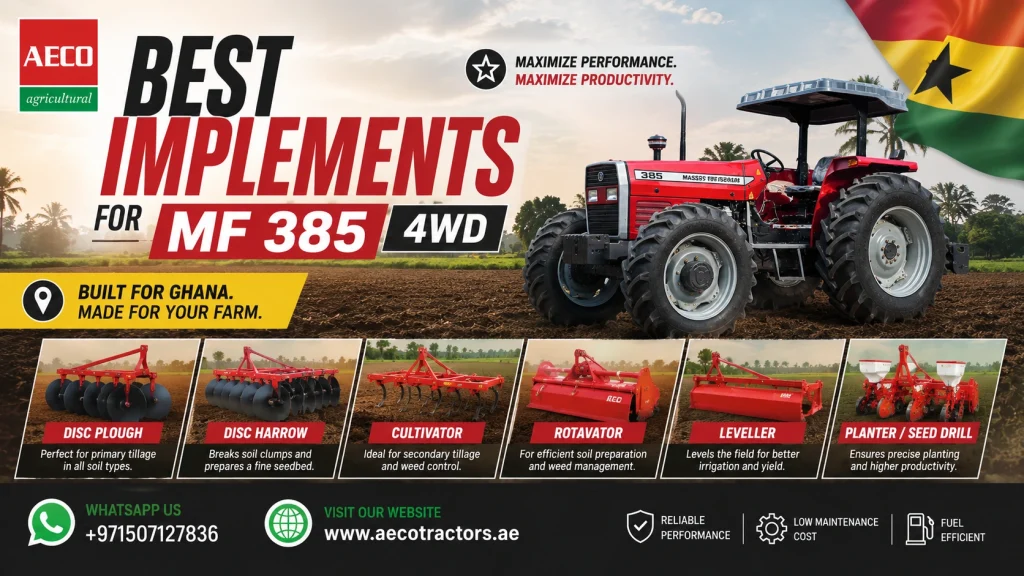
The Massey Ferguson 385 4WD is one of the most widely used tractors across sub-Saharan Africa, and Ghana is no exception. Walk through the farming communities of Brong-Ahafo, the Upper East Region, or the Ashanti agricultural belt, and you will find this tractor working across a range of crops and soil types.
But the tractor itself is only part of the equation. Without the right implements attached, even the most capable machine underperforms. This guide covers the implements that genuinely work well with the MF 385 4WD in Ghanaian farming conditions — not a generic list, but a practical breakdown based on what this tractor can handle and what farmers in this region actually need.
Understanding the MF 385 4WD Before You Choose Implements
Before selecting implements, it helps to understand what this tractor can and cannot do. The MF 385 4WD runs a 4-cylinder Perkins engine producing around 85 horsepower. It has a standard Category II three-point linkage (3PL), a rear PTO rated at 540 RPM, and a hydraulic lift capacity that typically handles loads in the range of 2,000 to 2,150 kg depending on configuration.
These are the numbers that matter when matching implements.
If you attach an implement that exceeds the hydraulic lift capacity or demands more PTO power than the engine can sustain under load, you will see poor performance, excessive fuel consumption, and premature wear on both the tractor and the implement.
The 4WD configuration specifically makes this tractor more capable on wet, loose, or sloped ground — conditions that are common during Ghana’s rainy seasons and across the Northern Savannah’s laterite soils.
Why Implement Selection Matters More Than Most Buyers Realise
Many farmers in Ghana invest in a good tractor and then attach whatever implement is cheapest or most available locally. This leads to two common problems.
First, undersized or poorly matched implements reduce field productivity. A light disc harrow that cannot penetrate compacted soil wastes fuel and time without delivering a proper seedbed.
Second, oversized implements that exceed the tractor’s rated capacity put stress on the hydraulic system, the rear axle, and the PTO shaft — reducing the tractor’s working life.
Getting the implement selection right from the beginning protects your investment and improves your output per hectare.
The Best Implements for the MF 385 4WD in Ghana
1. Moldboard Plough (4 to 5 Furrow)
For primary tillage in Ghana’s heavier soils — particularly the ferruginous tropical soils found across much of the Northern and Upper Regions — a moldboard plough remains one of the most effective tools for deep soil inversion.
A 4-furrow moldboard plough is the most practical match for the MF 385 4WD. A 3-furrow plough can be used in lighter soils, but in compacted or clay-heavy ground, the 85HP output will be working at or near its limit. Pushing beyond that consistently will show up in fuel costs and engine wear.
Moldboard ploughing is particularly useful before the first rains when soil is still firm and weed residue needs to be fully turned under. For maize, sorghum, and groundnut production — all major crops in Ghana’s agricultural zones — proper primary tillage sets the foundation for the rest of the season.
What to look for: Reversible moldboards extend working life and reduce turnaround time at field ends. Ensure the plough frame is rated for Category II linkage attachment.
2. Disc Harrow (Offset or Tandem)
A disc harrow is arguably the most versatile implement you can attach to the MF 385 4WD in Ghana. It handles secondary tillage after ploughing, breaks up clods, incorporates crop residues, and prepares seedbeds across a range of soil types.
For the MF 385 4WD, an offset disc harrow with 18 to 24 discs in the 560mm to 610mm diameter range works well. Tandem disc harrows are an option for larger operations but require careful weight management to stay within the tractor’s hydraulic lift capacity.
In Ghana’s savannah zones, disc harrows are often used as a standalone tillage tool — particularly on lighter soils where deep ploughing is not always necessary. Many commercial farms in the Brong-Ahafo and Northern Regions use disc harrowing as the primary seedbed preparation method for cereals.
Practical note: Disc blade thickness matters in rocky or laterite soils. Thinner blades dull faster and require more frequent replacement. Specify heavier-gauge blades if your fields contain surface stones or hardpan layers.
3. Rotavator (Rotary Tiller)
A rotavator is a PTO-driven implement that pulverises soil to a fine tilth in a single pass. For rice cultivation — which is expanding in Ghana’s Volta Basin and parts of the Central Region — a rotavator is often essential for preparing paddy fields.
The MF 385 4WD’s 540 RPM PTO is compatible with most standard rotavators in the 1.8m to 2.2m working width range. Going wider than 2.2m starts to push PTO demand beyond comfortable operating levels for sustained field work.
Rotavators are also useful for vegetable farmers in peri-urban areas around Accra, Kumasi, and Tamale who need fine seedbeds for tomatoes, pepper, and leafy vegetables. In these situations, a rotavator replaces multiple tillage passes and saves both time and fuel.
What to look for: Gear-driven rotavators are more durable than chain-driven models for heavy soil work. Look for replaceable L-shaped or C-shaped blades that are locally available or easy to source.
4. Maize Planter (2-Row or 4-Row)
Maize is Ghana’s most important food crop, and mechanised planting is increasingly adopted by commercial farmers and smallholders working with service providers. A 2-row or 4-row trailed or mounted maize planter is one of the most productive investments a farmer can make alongside a tractor like the MF 385 4WD.
A 2-row maize planter is manageable for most operators and suitable for fields up to around 20 to 30 hectares per season. For larger commercial operations, a 4-row planter significantly increases daily planting capacity.
These planters work from the tractor’s hydraulic system for depth control and can be set for different row spacings and seed populations depending on the maize variety being used — whether open-pollinated varieties (OPVs) or hybrid seed.
Practical note: Seed metering accuracy is critical. Planters with finger-pickup or precision plate mechanisms perform better than older brush-type systems, especially with smaller or irregular seed lots. Ensure the planter you buy can be calibrated for the seed sizes commonly available in Ghana.
5. Disc Plough (3 to 4 Disc)
In conditions where moldboard ploughs struggle — sticky black cotton soils, heavily root-matted ground, or areas with embedded crop residues — a disc plough is often the more practical choice.
Ghana’s transitional forest zones in the Brong-Ahafo Region and parts of the Ashanti Region have soils that can be difficult for conventional moldboard ploughs, particularly after heavy rains. A 3-disc plough mounted on the MF 385 4WD handles these conditions more reliably.
Disc ploughs also self-clean more effectively in wet conditions, reducing the constant manual clearing that moldboard ploughs sometimes require in sticky soils.
What to look for: Disc diameter of 660mm to 710mm is appropriate for the MF 385 4WD’s power range. Ensure the plough has adjustable disc angles to allow for different soil conditions and tillage depths.
7. Ridger (Single or Multi-Row)
Ridging is a standard practice for yam cultivation in Ghana, particularly in the Brong-Ahafo and Volta Regions where yam is a major commercial crop. A ridger attached to the MF 385 4WD forms the raised beds needed for yam mounds and also supports drainage management in rice and vegetable fields.
A single-body ridger is the most common configuration for the MF 385 4WD. Multi-row ridgers (3 to 5 bodies) can be used on lighter soils but require the 4WD traction to maintain consistent depth and row spacing across the field.
Ridgers are also used for earthing-up maize, forming irrigation furrows, and creating drainage channels — making them useful across multiple crops and seasons.
8. Subsoiler (Single or 3-Tine)
Compaction is a growing problem on commercial farms in Ghana, particularly on fields that have been under continuous mechanised cultivation for several seasons. A subsoiler breaks through the hardpan layer that forms below the normal tillage depth, improving water infiltration and root penetration.
A single-tine or 3-tine subsoiler is within the working capacity of the MF 385 4WD, particularly in the 4WD configuration which provides the traction needed for this high-draft operation. Working depth is typically 40cm to 60cm.
Subsoiling is not needed every season, but farms that have seen declining yields on previously productive land should consider it as part of a soil health programme. It is particularly relevant on the more intensively farmed lands around Ghana’s urban agricultural corridors.
9. Trailer (Farm Trailer, 3 to 5 Tonne Capacity)
A farm trailer is often overlooked in implement discussions but is one of the most practically useful attachments for any working tractor. The MF 385 4WD is regularly used for hauling harvested produce, inputs, and equipment across farm tracks and rural roads in Ghana.
A hydraulic tipping trailer with 3 to 5 tonne capacity suits the MF 385 4WD’s drawbar pull and hydraulic system. Single-axle tipping trailers are the most common configuration and are widely used across Ghana’s farming communities for maize, yam, and rice transport.
For farmers operating in areas with poor road access, a robust farm trailer reduces dependence on hired transport and keeps produce moving from field to storage or market without delay.
10. Fertiliser Spreader (Centrifugal or Spinner Type)
Fertiliser application efficiency directly affects yield outcomes, and manual broadcasting is both labour-intensive and imprecise. A PTO-driven or gravity-fed centrifugal fertiliser spreader mounted on the MF 385 4WD improves application uniformity and reduces input waste.
Spinner-type spreaders with 200kg to 400kg hopper capacity are practical for the MF 385 4WD and cover meaningful field areas per fill. They are compatible with the granular fertilisers most commonly used in Ghana — NPK compound fertilisers, urea, and sulphate of ammonia.
For rice farms operating under irrigation schemes or large commercial maize blocks, a fertiliser spreader pays back its cost quickly through reduced labour and more consistent crop stands.
Matching Implements to Ghana's Farming Seasons
Ghana has two main farming seasons in the south (major season: March to July; minor season: September to November) and a single main season in the north (May to October). Implement scheduling matters.
During land preparation windows — which are short and weather-dependent — having the right tillage implements ready and properly maintained determines whether you plant on time. Late planting in Ghana consistently reduces yield potential for maize and sorghum.
A practical implement set for a commercial farmer in Ghana operating the MF 385 4WD might look like this:
– Pre-season: Disc plough or moldboard plough for primary tillage, subsoiler for compacted fields
– Seedbed preparation: Disc harrow or rotavator
– Planting: Maize planter or ridger for yam
– Crop management: Boom sprayer, fertiliser spreader
– Harvest and transport: Farm trailer
This sequence covers the full production cycle and allows one tractor to carry the workload across multiple operations rather than being limited to a single function.
New vs. Used Implements: What Makes Sense for Ghana
The decision between new and used implements depends on your operating scale, budget, and access to spare parts.
New implements from reputable manufacturers offer warranty coverage, known specifications, and predictable maintenance requirements. For high-use implements like disc harrows, rotavators, and planters that work through every season, new equipment is often the more economical choice over a three to five year horizon.
Used implements can be viable for lower-frequency operations like subsoiling or for farmers who are testing a new implement type before committing to a larger investment. However, used implements imported without inspection carry risks — particularly worn disc blades, cracked frames, and seized bearings that are not always visible in photos.
When sourcing implements for export to Ghana, working with an experienced supplier who can verify implement condition and specification before shipment reduces these risks significantly.
Sourcing Implements for the MF 385 4WD: What Ghana Buyers Should Know
Most quality tractor implements used in Ghana are sourced from manufacturers in Pakistan, India, Turkey, and Europe. Pakistani-manufactured implements in particular have become widely used across West Africa because of their competitive pricing, compatibility with Massey Ferguson specifications, and availability of spare parts.
When importing implements, buyers should confirm:
– Linkage category compatibility — Category II for the MF 385 4WD
– PTO shaft speed compatibility — 540 RPM for most implements
– Working width and weight — within the tractor’s hydraulic lift and draft capacity
– Spare parts availability — blades, bearings, and wear parts should be sourceable in Ghana or through your supplier
AECO Tractors, based in the UAE, supplies Massey Ferguson tractors and matched agricultural implements to buyers across Africa and the Middle East. For Ghanaian buyers and importers looking to source MF 385 4WD tractors and compatible implements in a single shipment, consolidated export packages reduce freight costs and simplify procurement.
Common Mistakes When Buying Implements for the MF 385 4WD
Buying on price alone. The cheapest disc harrow or plough may use thinner steel, lower-grade bearings, and imprecise manufacturing tolerances. In hard Ghanaian soils, this translates to rapid wear and frequent breakdowns during the planting window.
Ignoring weight ratings. Overloading the MF 385’s hydraulic system with an implement that is too heavy strains the rear axle and reduces hydraulic lift performance over time.
Buying implements without spare parts availability. Some imported implements use non-standard bolt patterns, disc diameters, or bearing sizes that are not available locally. Before purchasing, confirm that wear parts — particularly disc blades, share points, and PTO shaft components — can be sourced in Ghana or through your supplier.
Skipping implement maintenance. Greasing implement bearings, checking disc blade condition, and inspecting linkage pins before each season is basic but often neglected. An implement that fails during land preparation can cost more in lost planting time than the implement itself is worth.
A Note on PTO-Driven vs. Ground-Driven Implements
Some implements — like certain seed drills and fertiliser spreaders — can be either PTO-driven or ground-driven (wheel-driven). For Ghana’s farming conditions, PTO-driven implements generally perform more consistently because they maintain metering accuracy regardless of ground speed variation. Ground-driven mechanisms can slip or stall in loose, sandy soils or when the implement bounces over uneven terrain.
For tillage implements like rotavators, PTO drive is standard. For planters and spreaders, specifying PTO drive where available improves field performance.
For more information on Massey Ferguson tractors and compatible implements available for export to Ghana, contact Aeco Tractors.
Frequently Asked Questions (FAQs)