
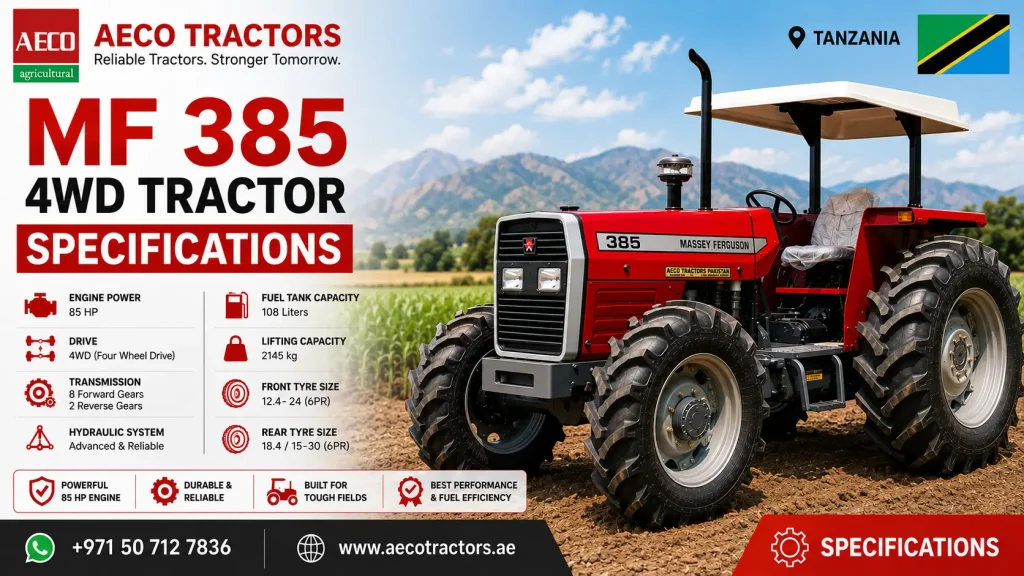
The Massey Ferguson 385 4WD is an 85hp agricultural tractor powered by a Perkins 4.1-litre direct injection diesel engine with four cylinders. It features a manual transmission with eight forward and two reverse gears, a Category II three-point linkage system, a 540/1000 RPM PTO, and a hydraulic position control system. Designed for medium to large-scale farming operations, the MF 385 4WD is widely used for tillage, planting, haulage, and implement-based fieldwork across East African farming conditions, including Tanzania.
MF 385 4WD Tractor Specifications: Complete Buyer's Guide for Tanzanian Farmers and Dealers
The Massey Ferguson 385 4WD is one of the most consistently purchased tractors across East Africa, and Tanzania is no exception. Whether you are managing a commercial maize farm in Mbeya, running a rice operation in Morogoro, or sourcing equipment for resale through an agricultural dealership in Dar es Salaam, this tractor comes up repeatedly for good reason.
It is not the flashiest machine on the market. It does not need to be. The MF 385 4WD earns its reputation through mechanical reliability, straightforward maintenance, and compatibility with the wide range of implements that Tanzanian farmers actually use.
This guide covers the full technical specifications, practical performance considerations, implement compatibility, and what to look for when purchasing — whether you are buying for your own operation or importing for commercial resale.
What the MF 385 4WD Is Designed For
The MF 385 4WD sits in the 85hp class — a power range that handles the demands of medium to large-scale farming without the fuel consumption and complexity of higher-horsepower machines.
In Tanzania, this tractor is commonly used for:
– Deep ploughing on black cotton soil and red loam in the Southern Highlands
– Disc harrowing and seedbed preparation ahead of planting seasons
– Subsoiling on compacted land that has seen repeated shallow tillage
– Maize, wheat, and sunflower cultivation across commercial farm blocks
– Haulage of produce and inputs using tipping trailers and flatbed attachments
– Irrigation support through pump-driven water systems connected via the PTO
The four-wheel drive configuration is particularly important in Tanzania’s rainy seasons, when field conditions deteriorate quickly and two-wheel drive tractors lose traction on wet, heavy soils.
MF 385 4WD Full Technical Specifications
Engine Specifications
| Specfications | Details |
|---|---|
Engine Make | Perkins |
Engine Model | Perkins 4.41 |
Engine Type | 4-cylinder, direct injection, naturally aspirated diesel |
Displacement | 4,084 cc (4.1 litres) |
Rated Power | 85 hp (63.4 kW) |
Rated RPM | 2,200 RPM |
Cooling System | Water-cooled |
Air Filtration | Dual-element dry air filter |
Fuel Tank Capacity | 108 Litres |
The Perkins 4.1D engine is one of the most significant reasons this tractor has maintained its market position across Africa. Perkins engines are known for their durability under continuous load, their tolerance of variable fuel quality, and the wide availability of genuine and compatible spare parts in East African markets including Tanzania, Kenya, and Uganda.
The naturally aspirated configuration means fewer components under the bonnet compared to turbocharged alternatives — which translates directly into lower maintenance complexity and reduced downtime risk in areas where specialist mechanical support is not always nearby.
Transmission Specifications
| Specfications | Details |
|---|---|
Transmission Type | Manual, synchromesh |
Forward Gears | 8 |
Reverse Gear | 2 |
Gear Ranges | High and Low range |
Clutch Type | Dual dry plate clutch |
The eight-speed manual gearbox with high and low range gives operators meaningful flexibility across different field tasks. Low range is used for heavy tillage work where torque demand is high and speed must be controlled. High range suits lighter fieldwork, road travel between fields, and haulage operations.
The dual dry plate clutch separates the engine drive from the transmission and PTO independently — a practical feature that allows PTO-driven implements to remain running while the tractor is stationary, which is important for operations like pumping, grinding, or auger work.
Four-Wheel Drive System
| Specfications | Details |
|---|---|
Drive Configuration | 4WD (Mechanical front-wheel assist) |
4WD Engagement | Manual engagement |
Reverse Gear | 2 |
Front Axle | Rigid, beam-type front axle |
Front Tyre Size (Standard) | 12.4-24 (6PR) |
Rear Tyre Size (Standard) | 18.4 / 15-30 (6PR) |
The four-wheel drive system on the MF 385 is mechanically engaged — the operator selects 4WD via a lever when conditions require it. This is a straightforward system that Tanzanian operators and mechanics are familiar with, and it adds meaningfully to traction on wet, loose, or uneven ground.
For farms in Tanzania’s high-rainfall zones — including Iringa, Mbeya, and Njombe — the ability to engage 4WD during land preparation in the short or long rains is not optional. It is operationally essential.
Hydraulic System
| Specfications | Details |
|---|---|
Hydraulic System Type | Open-centre, live hydraulics |
Hydraulic Pump Output | Approximately 35 litres per minute |
Three-Point Linkage Category | Category I & II |
Lift Capacity (at link ends) | Approximately 2,145 kg |
Hydraulic Control | Position control and draft control |
Auxiliary Hydraulic Outlets | Available (single or double acting) |
The hydraulic system on the MF 385 4WD is one of its strongest practical features. The position control function allows the operator to set a consistent working depth for mounted implements — useful for maintaining uniform plough depth across a field or keeping a disc harrow at a consistent penetration angle.
Draft control adjusts implement depth automatically in response to soil resistance — when the tractor encounters harder ground, the system raises the implement slightly to maintain consistent engine load and prevent bogging. This is particularly relevant on mixed soil profiles common in Tanzania’s farming regions.
The Category II three-point linkage is compatible with the majority of commercially available tractor implements compatible with the MF 385 in the Tanzanian market, including locally fabricated equipment and imported implements from India, China, and Europe
Power Take-Off (PTO) Specifications
| Specfications | Details |
|---|---|
PTO Type | Independent, live PTO |
PTO Speed | 540 RPM |
PTO Power Output | Approximately 72 hp (at PTO shaft) |
PTO Shaft Splines | 6-spline (540 RPM) |
The live, independent PTO is a significant operational advantage. Because the PTO runs independently of the ground drive, the operator can stop forward movement while keeping PTO-driven implements running — essential for tasks like operating a rotary tiller at the headland, running a water pump, or using a post-hole digger.
The 540 capability gives this tractor compatibility with a wider range of implements. Most traditional implements in Tanzania run at 540 RPM.
Electrical System
| Specfications | Details |
|---|---|
Battery | 12V |
Alternator Output | 55 Amp |
Starting System | Electric start |
Dimensions and Weight
| Specfications | Details |
|---|---|
Overall Length | Approximately 3,900 mm |
Overall Width | Approximately 2,100 mm (varies with tyre fitment |
Wheelbase | Approximately 2,150 mm |
Ground Clearance | Approximately 400 mm |
Operating Weight | Approximately 3,200 – 3,500 kg (depending on ballasting) |
Turning Radius (with brakes) | Approximately 3.8 metres |
The turning radius is worth noting for operators working smaller field plots or orchards. At under 4 metres with brake-assisted turning, the MF 385 4WD handles headland manoeuvres reasonably well for a tractor of this weight class.
Hydraulic Position Control: Why It Matters in the Field
Several competing sources mention hydraulic position control as a feature without explaining what it actually means for the operator. It deserves a clearer explanation.
When you are ploughing a field with a mounted mouldboard plough, you want consistent furrow depth across the entire field. Without position control, the depth varies with operator input and soil surface changes. With position control engaged, the tractor’s hydraulic system holds the implement at a fixed height relative to the tractor — meaning your furrow depth stays consistent even as the terrain undulates slightly.
For Tanzanian farmers working on large field blocks where uniform seedbed preparation directly affects germination rates and yield, this is a practical advantage, not just a specification point.
Implement Compatibility for Tanzanian Farming Conditions
The MF 385 4WD’s Category II three-point linkage and dual-speed PTO make it compatible with a broad range of implements. Below is a practical overview relevant to Tanzanian agricultural operations:
Tillage Implements
– Mouldboard Plough (3-4 furrow): Suitable for primary tillage on virgin land and seasonal land preparation. The 85hp output handles 3-furrow ploughing comfortably on most Tanzanian soils.
– Disc Plough (3-4 disc): Better suited to hard, dry soils and lands with heavy crop residue. Commonly used in Tanzania’s drier regions including Dodoma and Singida.
– Disc Harrow (18-24 disc): Used for secondary tillage and seedbed refinement. The MF 385 4WD handles medium-weight disc harrows effectively.
– Subsoiler (3-5 tine): For breaking hardpan layers that restrict root development and water infiltration. Increasingly important on intensively farmed land in the Southern Highlands.
Planting and Seeding
– Maize Planter (2-4 row): Compatible via Category II linkage and 540 RPM PTO drive where applicable.
– Grain Drill: For wheat and barley planting, particularly on commercial farms in Arusha and Mbeya regions.
Crop Management
– Rotary Tiller: Operates at 540 or 1000 RPM PTO input depending on the implement specification.
– Boom Sprayer (mounted): Hydraulically controlled boom sprayers can be mounted on the three-point linkage with auxiliary hydraulics managing boom folding.
Haulage and Post-Harvest
– Tipping Trailer (5-8 tonne): The MF 385 4WD is commonly paired with tipping trailers for produce haulage from field to store or market. The dual-clutch system allows smooth trailer coupling and decoupling.
– Water Pump (PTO-driven): Widely used in Tanzania for supplemental irrigation on horticultural farms and rice paddies.
Fuel Consumption and Operating Costs
Precise fuel consumption figures vary with load, soil type, implement, and operator practice. However, for planning purposes:
Under continuous heavy tillage load, the Perkins 4.1D engine in the MF 385 4WD typically consumes in the range of 8 to 12 litres per hour. Under lighter load — haulage, secondary tillage, or road travel — consumption drops considerably.
For a Tanzanian farming operation running this tractor through a 90-day land preparation and planting window, fuel cost is a significant budget line. Operators who use the correct gear selection — rather than lugging the engine in too high a gear — see meaningful reductions in fuel consumption and engine wear.
Engine oil service intervals on the Perkins 4.1D are typically every 250 hours under normal conditions. Air filter servicing in dusty conditions — common during Tanzania’s dry season fieldwork — should be done more frequently, sometimes every 50 to 100 hours depending on conditions.
What to Check Before Purchasing a Used MF 385 4WD
If you are considering a used unit rather than a new import, the following checks are worth prioritising:
Engine:
– Check for blue smoke at startup (worn piston rings or valve seals)
– Check for white smoke under load (possible head gasket or injector issue)
– Listen for knocking at idle — can indicate bearing wear on higher-hour engines
Transmission:
– Test all eight forward gears under light load
– Check for difficulty engaging or disengaging 4WD
– Inspect the dual clutch for slipping under load
Hydraulics:
– Test the three-point linkage under load — it should lift smoothly and hold position without drifting
– Check auxiliary hydraulic outlets for leaks and pressure consistency
Tyres:
– Rear tyre wear is expensive to replace. Check tread depth and sidewall cracking, particularly on units that have been stored outdoors.
Hours:
– A well-maintained MF 385 with 3,000 to 5,000 hours is generally still a viable working tractor. Above 6,000 hours, scrutinise the engine and drivetrain carefully.
New MF 385 4WD tractors available for Tanzania are typically sourced through export channels from Pakistan — where Massey Ferguson tractors are manufactured under licence by Millat Tractors and Al-Ghazi Tractors — or through authorised dealership networks.
Pakistan-manufactured Massey Ferguson tractors for Tanzania have an established track record across East and Southern Africa. The specifications are consistent with international MF standards, and spare parts availability has improved significantly in Tanzania over the past decade.
AECO Tractors, based in the UAE, supplies export-ready Massey Ferguson tractors including the MF 385 4WD to buyers across Africa and the Middle East. Their export process covers documentation, pre-shipment inspection, and shipping coordination — which is relevant for Tanzanian importers and dealers who need to manage the logistics of bringing equipment into the country via Dar es Salaam port.
For Tanzanian buyers, it is worth confirming the following before finalising any import purchase:
– Whether the unit is supplied with a pre-delivery inspection (PDI) certificate
– Spare parts availability in Tanzania or through the supplier’s network
– Warranty terms and how warranty claims are handled post-import
– Whether the supplier can provide a clean bill of lading and all customs documentation
MF 385 4WD vs Other Tractors in the Same Power Class
Tanzanian buyers often compare the MF 385 4WD against other options in the 75-95hp range. A brief practical comparison:
MF 385 4WD vs New Holland TD5.85:
The New Holland TD5.85 offers a more modern cab design and electronic controls, but comes at a higher price point. The MF 385 4WD is simpler mechanically and typically easier to maintain in areas with limited dealer support.
MF 385 4WD vs Farmtrac 80:
The Farmtrac 80 is a lower-cost alternative but generally has a smaller dealer and parts network in Tanzania. The MF brand recognition and parts availability give the MF 385 4WD an advantage for buyers outside major urban centres.
MF 385 4WD vs MF 375:
The MF 375 4WD Tractor is the 75hp sibling in the same family. If your primary work is lighter tillage or haulage on smaller plots, the 375 may be sufficient. For deep ploughing on larger blocks or heavier implement work, the additional 10hp in the 385 is meaningful.
Tanzania-Specific Considerations for MF 385 4WD Operators
Altitude: Farms in Tanzania’s Southern Highlands — Mbeya, Njombe, Iringa — sit at elevations between 1,500 and 2,700 metres above sea level. Naturally aspirated diesel engines lose power at altitude due to reduced air density. At 2,000 metres, expect a power reduction of approximately 6-8% from the rated 85hp. This is worth factoring into implement selection for high-altitude farms.
Fuel Quality: Diesel quality in rural Tanzania can be variable. The Perkins 4.1D engine handles fuel quality variation better than some more sensitive modern engines, but using a quality fuel filter and replacing it on schedule remains important.
Spare Parts: Perkins engine parts, MF transmission components, and hydraulic seals are available through agricultural suppliers in Dar es Salaam, Arusha, and Mbeya. Buyers in more remote areas should carry a basic stock of service consumables — air filters, fuel filters, oil filters, and hydraulic seals — to avoid extended downtime.
Operator Training: The MF 385 4WD is mechanically straightforward, but operators who understand gear selection, draft control adjustment, and correct PTO engagement procedures will get significantly better performance and lower running costs from the machine.
Frequently Asked Questions (FAQs)
The MF 385 4WD is powered by a Perkins 4.41 four-cylinder, naturally aspirated direct injection diesel engine producing 85 horsepower at 2,200 RPM. It is water-cooled and has a displacement of approximately 4,084 cc.
he MF 385 4WD has eight forward gears and two reverse gears, arranged in high and low ranges, giving operators flexibility for different field tasks and travel speeds.
The three-point linkage on the MF 385 4WD has a lift capacity of approximately 2,145 kg at the link ends, with Category II linkage compatibility for standard agricultural implements.
Yes. The MF 385 4WD with its 85hp Perkins engine handles three to four furrow mouldboard ploughing and three to four disc ploughing comfortably on most Tanzanian soil types, including the heavy black cotton soils found in some parts of the country.
The MF 385 4WD offers dual PTO speeds of 540 RPM and 1000 RPM, making it compatible with a wide range of agricultural implements. The PTO is live and independent, meaning it continues to operate when the tractor is stationary.
Yes. The MF 385 4WD is available for export to Tanzania through agricultural machinery exporters. Buyers should confirm documentation requirements for Tanzanian customs, including the bill of lading, certificate of origin, and pre-shipment inspection certificate.
The fuel tank capacity is approximately 108 litres, providing a reasonable operational range for full-day fieldwork without refuelling.
The naturally aspirated Perkins engine will experience a modest power reduction at high altitude — typically 6-8% at 2,000 metres above sea level. For farms in the Southern Highlands, this should be factored into implement selection and load planning.
Looking to Import the MF 385 4WD to Tanzania?
AECO Tractors supplies export-ready Massey Ferguson tractors — including the MF 385 4WD — to buyers across Africa and the Middle East. Whether you are a farm owner, agricultural dealer, or commercial importer, our team can assist with specifications confirmation, export documentation, and shipping coordination to Dar es Salaam and beyond.
Contact AECO Tractors directly through Contact Page to request availability, pricing, and export details for Tanzania.
Published by AECO Tractors — Agricultural Machinery Specialists for Africa and the Middle East