


Description
Fertilizer Broadcaster Spreader: Boost Your Soil Health and Save Time
Fertilizer is one of the biggest expenses for any farmer. If you are spreading it by hand, you are likely wasting money. Manual spreading is uneven; some plants get too much nutrient (burning them), while others get too little (stunting growth).
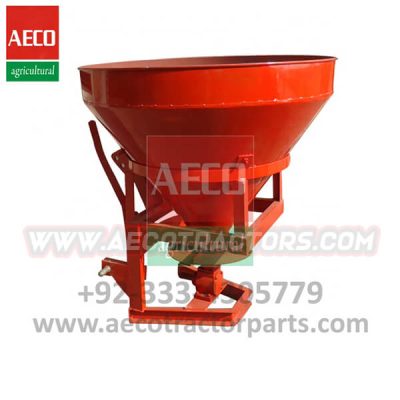
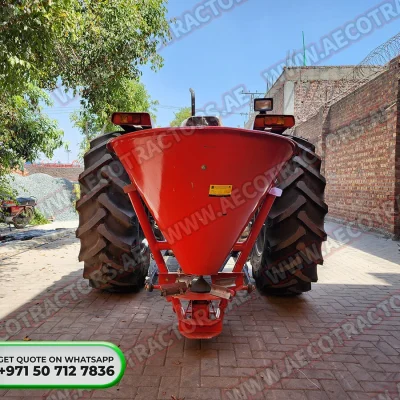
The Aeco Export Company’s Broadcaster Spreader (also known as a Fertilizer Spreader) solves this problem instantly. It is a simple, robust, and highly effective tractor attachment designed to distribute granular material evenly across your fields. Whether you are seeding a new pasture or top dressing a wheat crop with Urea, this machine ensures consistency.
How the Broadcaster Spreader Works
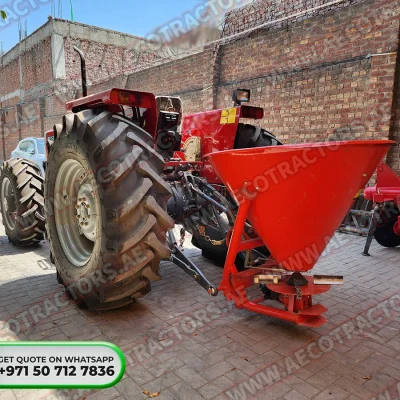
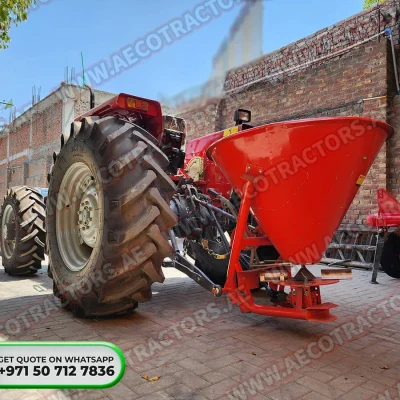
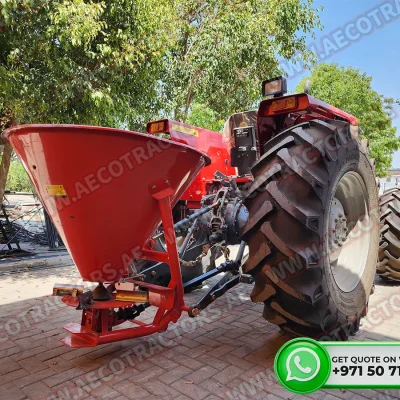
Simplicity is the key to reliability. The broadcaster mounts to the 3 point linkage of your tractor. Here is the breakdown of its operation:
- The Hopper: You load your fertilizer or seeds into the large conical hopper. Gravity feeds the material down to the bottom.
- The Agitator: Inside the hopper, a small mechanical agitator spins to prevent the fertilizer from “bridging” or clogging, ensuring a smooth flow.
- The Spinning Disc: Powered by the tractor’s PTO shaft, a disc at the bottom spins at high speed. As material falls onto this disc, vanes fling it outward in a wide, uniform semi-circle (up to 14 meters wide).
- Control Levers: You can adjust how much fertilizer is released by opening or closing the shutter gates using a simple lever accessible from the driver’s seat.
Why Every Farm Needs a Mechanical Spreader
Using a machine isn’t just about being lazy; it’s about being smart with your resources.
- Speed: A single operator on a Massey Ferguson 240 can cover 20 acres in the time it takes a manual team to cover 2 acres.
- Precision: By setting the flow rate correctly, you know exactly how many kilograms of product you are applying per acre. This prevents over-fertilization, which is bad for the soil and your wallet.
- Versatility: It’s not just for fertilizer. You can use it for broadcasting wheat seeds, cover crops, or even spreading salt and sand on icy roads in winter climates.
Compatibility: Will it Fit My Tractor?
The beauty of the Aeco’s Broadcaster is its universal design. It is compatible with almost any tractor that has a standard 540 RPM PTO shaft and Category 1 or 2 linkage.
- Small Farms: For compact tractors like the MF 260, our 300kg model is perfect. It is light enough not to unbalance the tractor but holds enough material to reduce refill trips.
- Large Operations: For larger tractors like the Massey Ferguson 385 4WD, the 500kg or larger capacity spreaders allow you to work large fields with fewer stops.
Pro Tips for Perfect Spreading
To get the most out of your Farm Implements, you need to use them correctly. Here are tips from our experts:
- Check the Height: The spreader should be level. If the front is tilted down, it will throw fertilizer into the ground. If tilted up, it will throw it into the air. Keep the spinning disc about 70-80cm above the crop canopy.
- Maintain Consistent Speed: Your spread rate depends on your driving speed. If you drive faster, you spread less product per meter. Find a comfortable gear (usually 2nd high) and stick to it.
- Wind Awareness: Avoid spreading on very windy days. The wind will blow the lightweight granules to one side, leaving strips of your field unfertilized.
- Overlap Your Passes: To ensure no gaps, drive so that your current spread pattern slightly overlaps the edge of your previous pass.
Maintenance Guide for Long Life
Fertilizers (especially Urea and DAP) are highly corrosive. If you leave them in the machine, they will eat through the metal.
- Wash Immediately: As soon as you finish, empty the hopper and wash the entire machine with water.
- Oil the Metal: After washing, spray a light coat of oil or diesel on the metal parts to prevent rust during storage.
- Grease the PTO: The PTO shaft and the gearbox have grease nipples. Pump grease into them every 10-15 hours of operation to keep the gears running smoothly.
Efficiency is Profit
In farming, time is money, and fertilizer is expensive. Our Broadcaster Spreader helps you save both. It is a low-cost investment that pays for itself in just one season through labor savings and improved crop yields.
Ready to upgrade your farm? We have these units in stock and ready for export to the UAE, Oman, Africa, and beyond.
Frequently Asked Questions (FAQs)
Broadcaster spreaders are designed primarily for granular material (pellets). Powdered fertilizer (like lime flour) is too light; it will drift in the wind and won’t flow well through the hopper gravity feed.
The spreading width is determined mainly by the PTO speed. Running the PTO at the standard 540 RPM will give you the maximum width (approx 12-14 meters). Slowing the engine RPM will reduce the width.
Yes. We use a heavy-duty, sealed gearbox filled with oil. As long as you check the oil level periodically and don’t hit large rocks with the spinning disc, the gearbox is designed to last for many years.


